Many drawings we receive from customers have one simple note: “Polishing.” At first glance, it seems clear. But in reality, polishing can mean very different things:
Sometimes it’s just to remove sharp edges.
Sometimes it’s for a decorative finish.
Sometimes it’s for a specific technical surface grade.
Key point: Without knowing the purpose, the quotation can easily go wrong, and the result may not meet your expectations. The real key is not polishing itself, but the reason why you need polishing.
Three Common Purposes of “Polishing”
1) Functional Polishing — Smooth and Safe to Touch
For nearly 80% of projects, the goal of polishing is simple:
Remove burrs and sharp edges
Make the surface smooth so it won’t hurt the user
Right approach: Complex mirror polishing is not required. Simple processes such as sandblasting or adding a small chamfer during CNC machining are usually enough. This not only achieves the goal but also avoids unnecessary cost.
2) Decorative Polishing — Aesthetic & Brand Perception
Some customers require parts with a flawless appearance:
No tool marks or scratches
Premium surface for consumer-facing products
In these cases, we may recommend finishes such as:
| Finish | Look & Notes | Typical Use |
|---|---|---|
| No.4 / Satin | Fine brushed look; soft reflection. | Electronics housings, panels. |
| Hairline | Long, consistent grain; premium texture; hides minor scratches better. | High-end panels, consumer devices. |
| BA / 8K Mirror | High reflectivity; 8K is ultra-mirror with minimal distortion. | Luxury & decorative applications. |
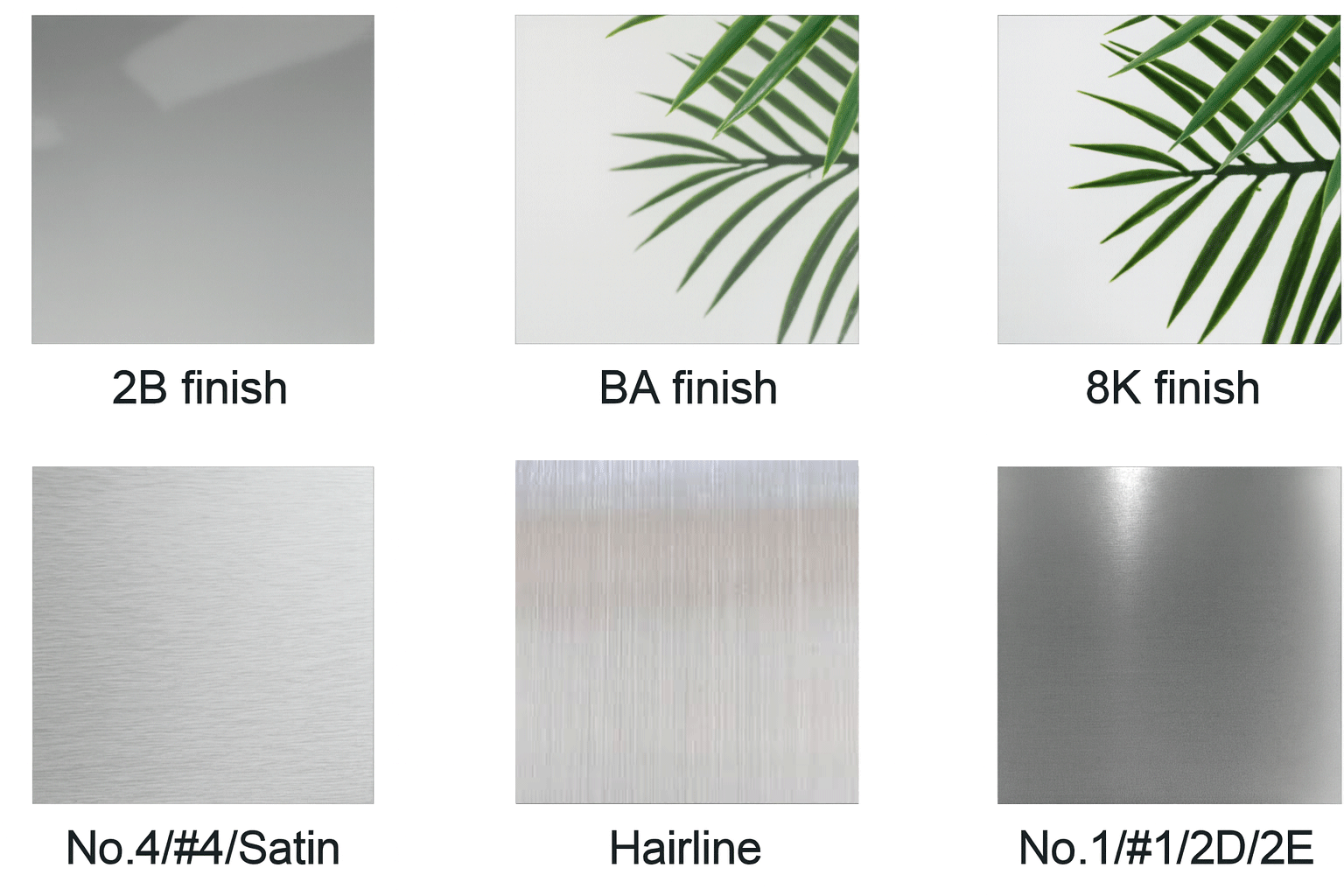
Customers often provide a reference picture to show the desired look.
However, for some CNC parts with complex geometries, it is not always possible to achieve the same surface finish as on flat or simple parts. Corners, deep pockets, or irregular shapes may limit polishing results. Our engineers provide a feasibility assessment of the design and recommend the most practical surface finish for your specific part.
3) Technical Polishing — Defined Surface Standards
Professional engineers sometimes specify clear requirements such as:
Surface roughness values (e.g., Ra 0.8)
Industry standards (#8 Mirror, BA Finish, etc.)
For these cases, the purpose is well defined. Our job is to match the required finish with the product’s geometry and feasibility, ensuring the result meets both functional and compliance standards.
Extended process time — 8K mirror requires multiple polishing and buffing stages.
Strict quality inspection — tiny defects (scratches, pits) are not acceptable.
Higher manual input — hand polishing on complex geometries is labor-intensive.
Material removal — more polishing means more surface loss, which adds difficulty.
As a result, prices can be significantly higher than simple deburring or decorative polishing.
You Don’t Need to Be an Expert in Polishing
As a customer, you don’t need to worry about choosing the right technical term. What matters most is telling us the purpose of polishing:
Is it for safety?
Is it for appearance?
Is it for technical compliance?
Once we understand the purpose, our engineers will recommend the most suitable process for your design. This way, you save time, avoid miscommunication, and get exactly what you need.
Conclusion
Next time you prepare a drawing or RFQ, remember: “Polishing” is not a single process — it’s a result that depends on your purpose.
At Bergek CNC, we don’t expect you to know every detail of manufacturing. Just tell us the goal, and we’ll translate it into the right process.
Need help choosing the right surface finish for your product? Talk to our engineers today.