One-stop solution for Sheet Metal Fabrication & CNC Machining - Bergek CNC
Language
One-stop solution for Sheet Metal Fabrication & CNC Machining - Bergek CNC
Master thermal management with our complete guide to custom liquid cold plates. Explore CNC machining, 7 key types, and top AI & industrial applications.
Why Need Liquid Cold Plates?
As electronics are miniaturizing, the challenge has now shifted from making things small to managing atomic-level problems and heat removal. We have seen processors that drive AI accelerators and next-generation data centers shifting from the 16 nm Nvidia Pascal P100 to 1.6 nm TSMC's A16. Scientists and engineers are forced to switch to angstroms as measuring units instead of nanometers.
Shrinking the electronics comes with a massive increase in power density. These devices generate heat due to internal resistance against moving current. Removing the heat produced in advanced electronics is the real challenge, which is why we need liquid coldplates. They overcome the air cooling practical limit of ~50 W/cm2. Imagine the size of an air cooler removing 1,000 W from an EV battery module. It's impractical. In comparison, liquid cold plates utilize micro-skiving or precision CNC machining to create fins that increase contact area by 1,600% in some cases.
The application of liquid cold plates is not limited to electronics for computation. Their use in power Insulated-Gate Bipolar Transistors (IGBTs) and Silicon Carbide (SiC) modules means removing 10 to 50 kilowatts of waste heat from an inverter. These can be as large as 1 meter in length.
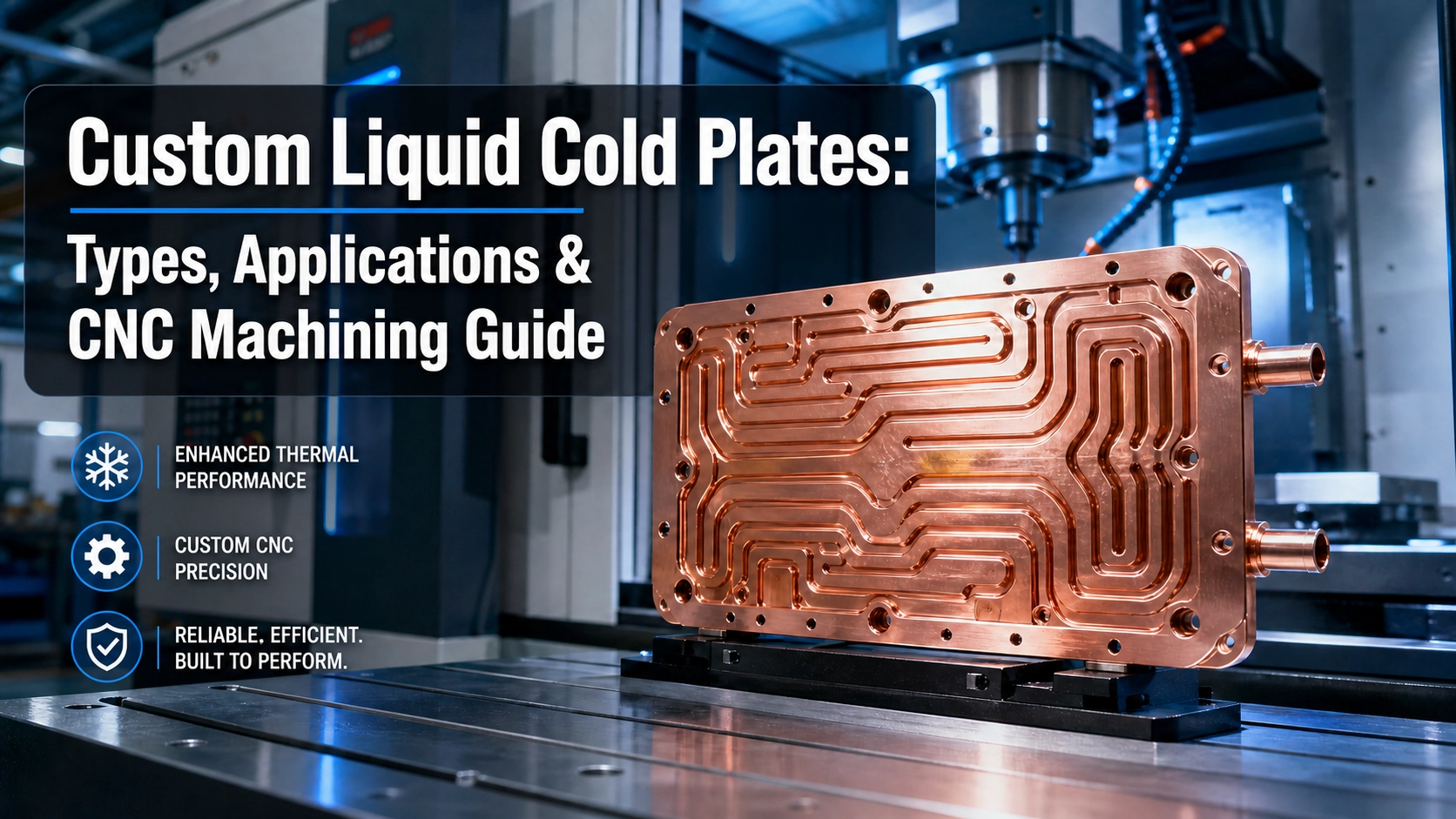
How Do Liquid Cold Plates Work? The Core Principles of Heat Transfer
To understand, let's take a convenient example of a computer processor. It generates the heat due to internal resistance against moving electricity and millions of switches firing on and off. The liquid plate sits on top of the processor. As the plate is highly conductive, the heat is transferred metal to metal using a suitable thermal solution. The heat then spreads across the internal micro-channels and fins machined into the liquid cold plate.
A cold fluid, preferably water-glycol or dielectric, is pumped into the inlet port of the liquid cold plate. It forces fluid to flow over the micro-channels and take their heat. The forced convection raises the temperature of the fluid at the exit, which then goes into a remote heat exchanger or radiator, which rejects heat to the ambient air. All of the liquid flows in a continuous closed loop with a reservoir for makeup or leakage monitoring. The performance of a liquid cold plate depends on flow rate, pressure drop, and channel geometry.
The following are the equations that are used for the liquid cold plate:
Fourier's law for conduction(Q=kATd)
Simplified Navier-Stokes for incompressible fluid flow for CFD modeling.
Liquid Cold Plates vs. Air Cooling Comparison
When comparing liquid cooling plates with air cooling, we need to understand their advantages and limitations. As the name suggests, liquid cooling uses liquid, which technically offers better heat transfer properties due to the higher value of the convective heat transfer coefficient. It does a better job at extracting heat from small surface areas in comparison to air.
Air cooling requires radiators directly mounted onto the heat source. It requires massive cooling fans running at high speeds to achieve the desired cooling rates. It can make equipment very large, bulky, and in some cases impractical, as we mentioned earlier.
Liquid cooling uses a pump to flow across microchannels within the fluid path that increases the contact area with the heated surface. A standard 50 mm by 50 mm contact area is 2,500 mm2. Through microchanneling with fins 5mm tall and 0.1mm gap, the surface area can reach 40,000 mm2. It also converts liquid to turbulent flow, which improves heat transfer capability. Later, the heat is taken by liquid to a decoupled heat rejection location.
Let's compare them head-to-head in a table to see how they stand up against each other across various parameters:
Metric | Air Cooling | Liquid Cold Plates | Key Advantage of Liquid |
Thermal Resistance | ~0.15°CW | <0.05°CW | 3x better heat transfer |
Heat Flux Capacity | Up to ~50 W/cm2 | 200+ W/cm2 | 4x higher power density |
Noise Level | High (loud fans) | Very low (pump only) | Quieter operation |
Size/Weight | Large and heavy | Compact and lightweight | Miniaturization |
Energy Efficiency | Lower | Significantly higher | Reduced operating costs |
Temperature Control | Moderate accuracy | High precision (+1-2 °C) | Uniform cooling |
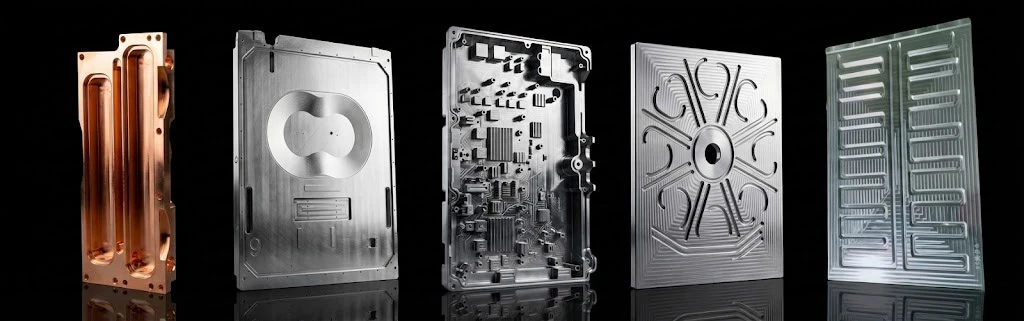
Common Types of Liquid Cold Plates
Depending on the application, there are mainly seven types of liquid cold plates. Some are designed for high-pressure applications, while others are made with durability and affordability in mind. Here are all the common types with details:
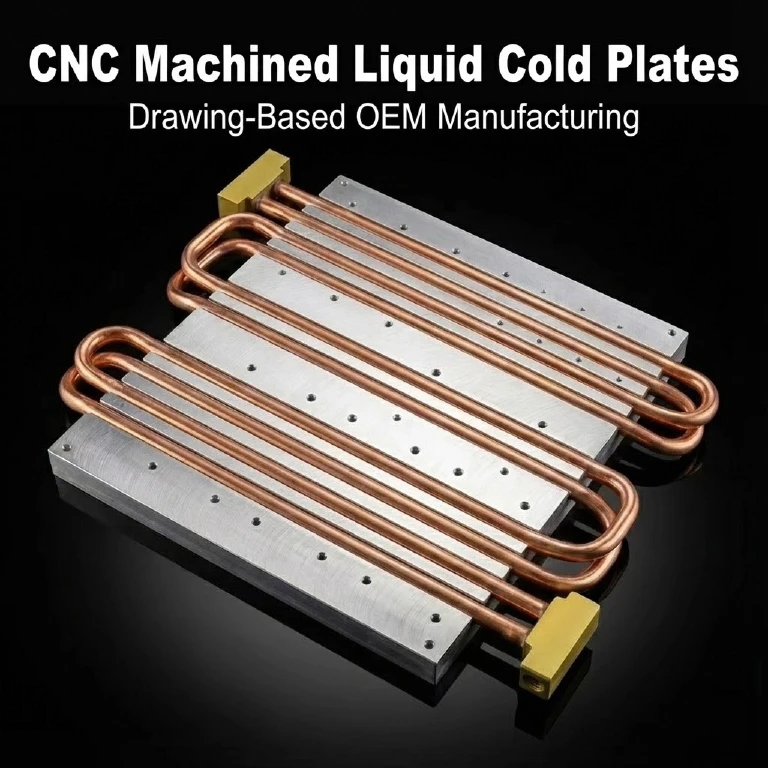
CNC Machined Liquid Cold Plates
These are the premium liquid cold plates that are manufactured using CNC machines. These machines create complex channels that enhance the heat transfer capability while ensuring that the flow faces minimal pressure drop. Owing to their complex machining process, they have a higher cost.
Vacuum Brazed Cold Plates
Vacuum brazed cold plates are made using a high-temperature vacuum furnace. Two parts, usually the base and cover, are placed over each other with a very thin layer of brazing alloy placed between them. The heat allows the alloy to melt and seal the two parts perfectly through a metallurgical bond.
Friction Stir Welded (FSW) Cold Plates
FSW uses the friction created by a high-speed rotating tool. The tool has two parts: the front that goes into the intersection of two metals being welded, like a drill. Then the other section touches, which rotates like a disc over the cold plate material. The friction results in enough heat to make metal behave like plastic and join together seamlessly.
Extruded Cold Plates
A heated billet of aluminum is pressed against a shaped steel die. The force causes the aluminum to take the shape of the die. It helps create long sections of cold plates. These offer low cost owing to their high manufacturing volumes.
Stamped Cold Plates
The process uses a large mechanical press with custom die stamps. The fluid channel pattern is pressed onto the sheet. The two sheets are then bonded, brazed, or welded together to form a closed liquid flow path.
Tubed (Press-Fit/Epoxy)
A large cold plate base is machined to have grooves to accommodate tubes that carry heat-transferring liquid. Then the tubes are placed over the grooves in the same pattern and pressed into the groove. A high-conductivity thermal epoxy is used between the tube and the base plate to fill the microscopic gaps.
Gun Drilled
A straight and long drill bit directly machines inside the liquid cold plate. The entry points of the drill bit are then sealed off using plugs. These are highly durable under burst pressures and usually cost more in comparison to other methods.
Type | Manufacturing Method | Thermal Performance | Cost Profile | Channel Complexity | Pressure Handling /Drop Control |
CNC Machined | Channel sprecision-milleddirectly from solid metal blocks | Very High | High | very High | Excellent |
Vacuum Brazed | Multi-layer CNC plates joined in a vacuum furnace with brazing alloy. | Excellent | Medium-High High | High | Good |
Friction StirWelded (FSW) | Solid-state weldingvia friction; no melting of the base metal. | Excellent | Medium-High High | High | Good (Excellent burst strength) |
Extruded | Aluminum forced through a die to create long profiles with internal passages. | Moderate to Good | Low | Low toMedium | Moderate |
Stamped | Thin sheets stamped into shape and bonded/brazed together. | Moderate | Low | Low | Limited |
Tubed(Press-Fit) | Continuous metaltubes pressed intoCNC-machinedgrooves with thermalepoxy. | Good | Low-Medium | Flow Path Flexibility | High (Tubes contain pressure) |
Gun Drilled | Deep, straight holesbored directlythrough thick, solidmetal blocks. | Good | High | Low (Straightlines only) | Extreme |
Complete Guide to CNC Machining for Custom Liquid Cold Plates
To fully understand how CNC-machined custom liquid cold plates are manufactured. Here is a breakdown of the process into key sections:
Modelling and Material Selection
Designing as per the requirement is the first step for engineers developing custom liquid cold plates. It means 3D modelling the final product, its breakup, and development drawings. Then the model is converted into a CNC machine program, and the right material is selected. Typically, aluminum (6061/6063), Copper (C110), SS, or Titanium are used.
Using CNC Mills
The machines that manufacture custom liquid cold plates are usually 3 to 5-axis CNC mills. These machines can tilt and rotate the block to carve out complex shapes with an extreme tolerance of ±0.1 mm.
Precision Check and Sealing
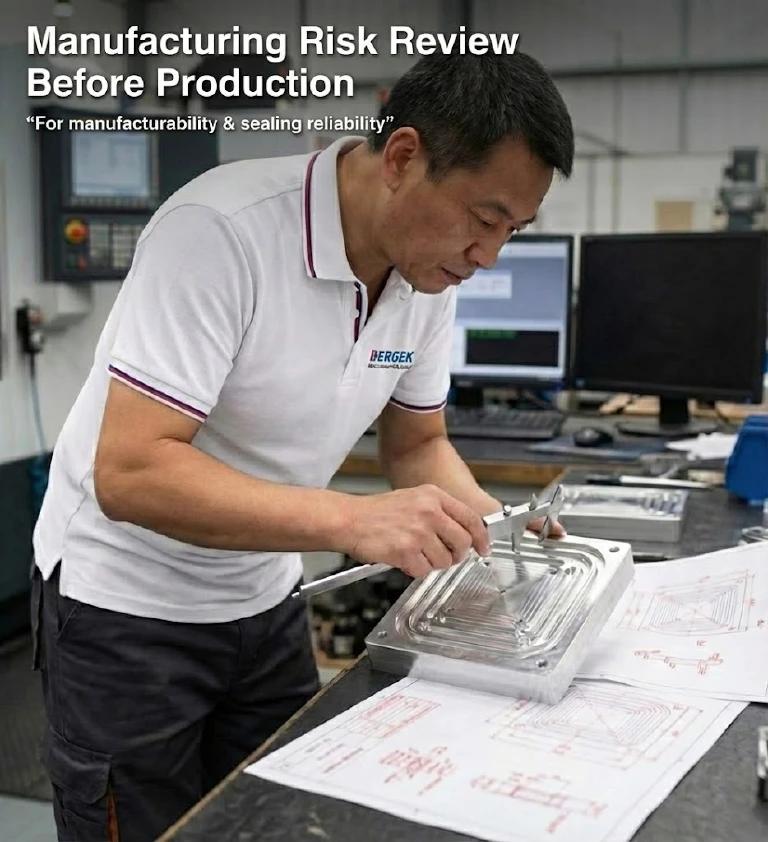
The CNC machine removes the material to create the tub and fins in the base plate. It's vital to ensure that the machining is precise and there are no microscopic burr that can later break away and clog the closed-loop bath. Then the top cover is sealed onto the base using the advanced techniques mentioned earlier.
Testing
Finally, after the manufacturing process is complete, the custom liquid cold plate is tested against high pressure. Instead of using water to fill the block, they use helium gas to pressurize the sealed cold plate. If it holds the helium, then there are no microscopic fractures through whichwater can see.
Unique Insight: Modern modeling software uses implicit to generate complex structures called TPMS (Triply Periodic Minimal Surfaces). These are different from the straight fin design and offer a complex sponge-like metal shape.
How Do You Choose the Right Liquid Cold Plate? 4-Step
Step 1: Define Requirements
First, define the amount of heat produced at the source so that the liquid cold plate design can be selected. Define the max allowable temperature, inlet fluid temperature, flow rate, pressure drop limit, and mechanical constraints like the size and mounting.
Step 2: Select Material
As mentioned earlier, the designer then has to choose a material. The selection will result in varying meta conductivity, look for aluminum (~167-235 W/m.K) for weight and cost balance. Consider copper (~385-400 W/m.K) for maximum flux, or stainless for corrosion resistance.
Step 3: Optimize Design via CFD Simulation
Precisely test channel layouts, fin parameters, and flow balance. Itreatively improve the design based on results to achieve uniform temperature and minimal pressure drop.
Step 4: Balance Performance vs. Manufacturability and Cost
To be fully confident in the design, go for a prototype with CNC for low volume. Later transition to die-cast or extruded for large-scale volumes. Subject the prototype liquid cold plate to full heat load for thermal testing.
Top Applications of Custom Liquid Cold Plates in Electronics & Industrial Cooling
1. Data Centers & AI: Direct-to-chip cooling manages 100kW+ racks, maximizing server density and lowering PUE.
2. Electric Vehicles (EVs): FSW plates deliver uniform battery cooling during fast charging to prevent thermal runaway.
3. Power Electronics: Custom plates stabilize high-voltage components (IGBTs, SiC) in harsh industrial and rail environments.
4. Medical & Lasers: Provides extreme temperature precision (±0.5 deg °C) to maintain accuracy in imaging coils and optics.
5. Aerospace & Renewables: Lightweight, high-pressure designs withstand extreme vibration and microgravity.
Why Should You Partner with a Custom Cold Plate Manufacturer?
Owning a completely custom-made cold plate is a premium choice in comparison to off-the-shelf solutions. A manufacturer of cold plates can alter geometries, materials, and flow paths to offer the lowest resistance and maximize surface area for heat transfer efficiency. Most of them provide end-to-end support starting from the CFD simulation, rapid CNC prototyping, advanced sealing (FSW/brazing), and 100% leak/thermal validation.
Conclusion
A high-end manufacturer can scale production from prototype to high volumes without setting limits on MOQs. Typically, an expert custom cold plate manufacturer will offer regulatory compliance like IATF 16949 and material compatibilities for various industrial applications.
Scalability from single prototypes to high-volume production without minimum-order quantities or performance compromises. Reduce your risk of losing capital and partner with a custom coldplate manufacturer for your next project.
FAQs
Q1: What is the difference between a cold plate and a heat sink?
A heat sink uses air to cool the base plate with fins directly using high-speed fans. Liquid cold plates use fluid to remove heat from the base plate and offer far higher heat removal capacity. Typically, a heat sink can reach a flux of 10 to 50 W/cm2. In comparison, a cold plate can reach 500 to 1,000 W/cm2.
Q2. Which coolant should I use to prevent leaks?
Preventing leaks starts with using advanced techniques, such as vacuum brazing, FSW, and testing the manufacturer's custom liquid cold plate with helium pressurization. If the liquid cold plate does not leak, then the next step is using deionized water with glycol for freeze/corrosion protection and dielectric fluids for electrically sensitive applications.
Q3: What is the typical lifespan?
Properly sealed copper or FSW aluminum plates exceed 10 years with routine fluid maintenance.
Q4: Are cold plates suitable for low-volume production?
Yes, CNC machining supports economical prototypes and custom runs without tooling investment. You can further reduce the risk by CFD validation in the early phases of production, preventing costly redesigns and confirming system-level performance.
Get In Touch With Us!
Bergek CNC is a world-class manufacturing service provider in Shenzhen. We have advanced equipment to provide a full range of customized products to manufacturers around the world, specializing in CNC machining and sheet metal processing.
If you have any question,please contact us.

Copyright © 2026 SHENZHEN BERGEK TECHNOLOGY CO., LTD. - www.bergekcnc.com All Rights Reserved.